The Wooden Slabs of Jukkasjärvi Bear Witness to the Significance of Journeys to Distant Lands
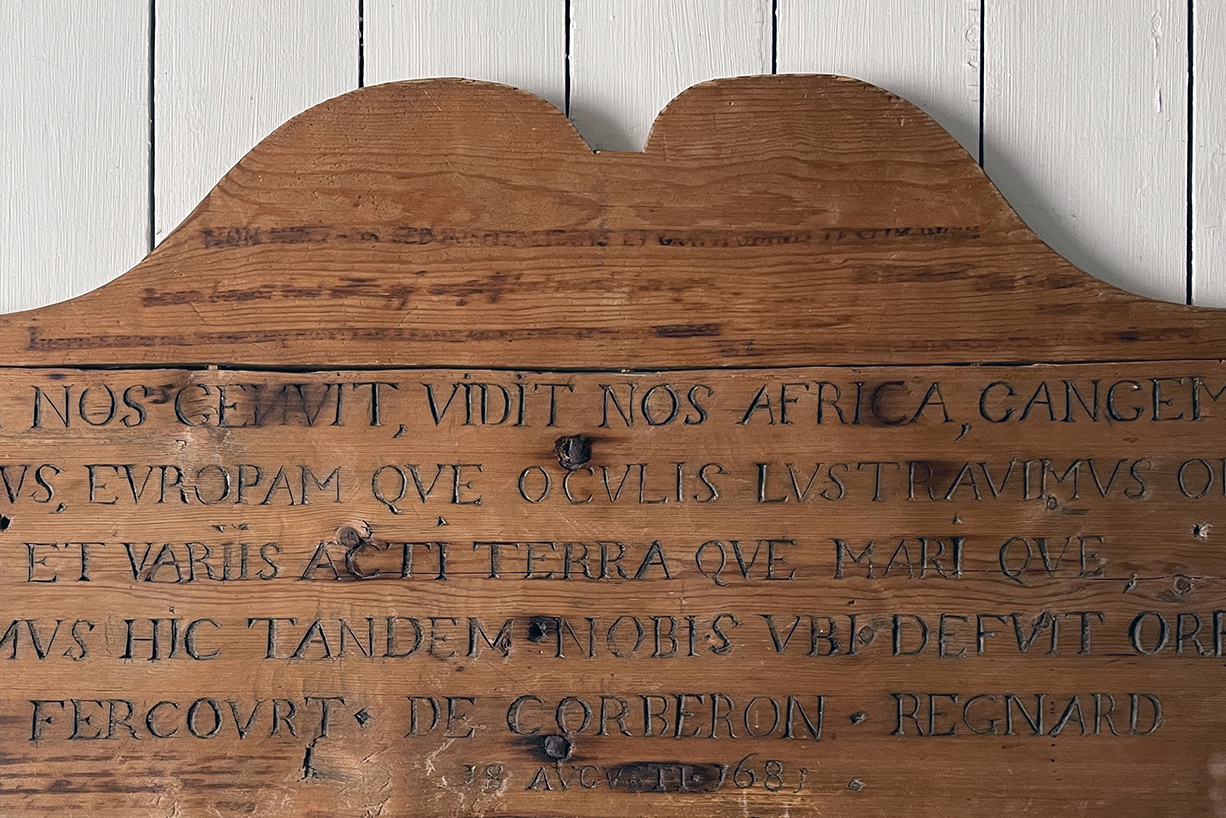
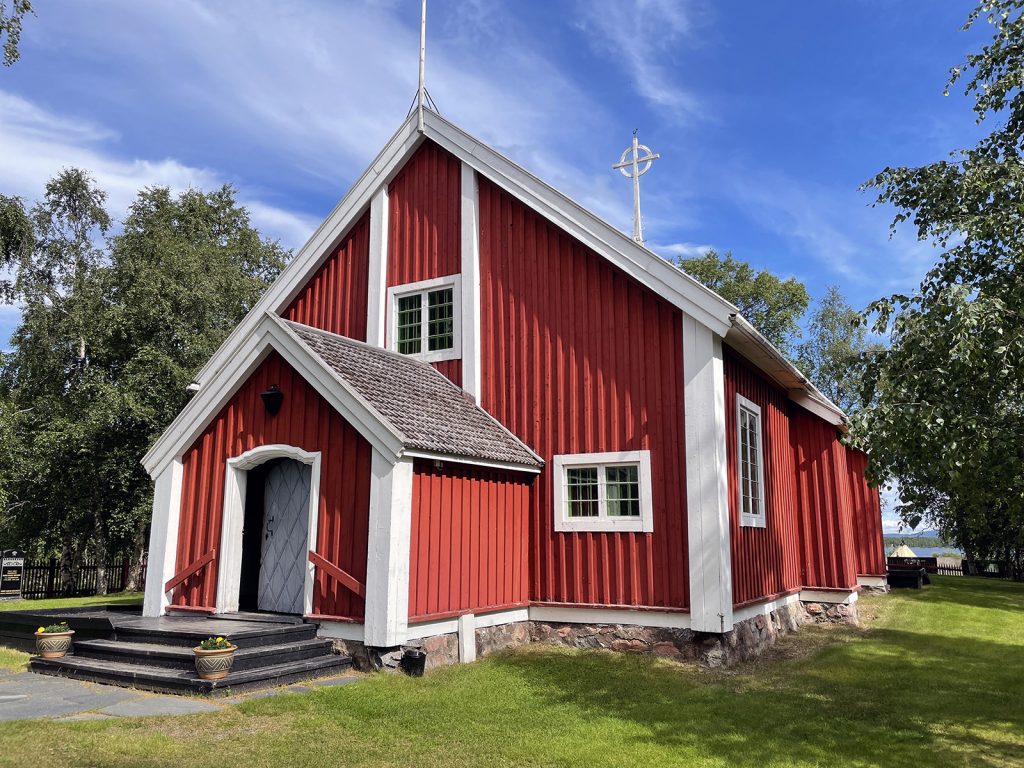
French scholar of travel literature, Professor Sylvie Requemora, has studied the wooden slabs preserved in the church of Jukkasjärvi, near Pajala, which travellers left behind as signs of their visit. These carved slabs are displayed on the wall of the church entrance hall.
Sylvie Requemora spoke about the traces left by travellers in Jukkasjärvi at the Maupertuis Expedition 290 Symposium on 5 September 2026 in a presentation entitled Wooden Slabs in Jukkasjärvi: Signs of French Travellers in the North. Her article, on which this text is based, is available online under the title: Signs of Travel and Memory: The Case of the Wooden Slabs in Jukkasjärvi (1681–1736).
Regnard’s Memorial Slab, 1681
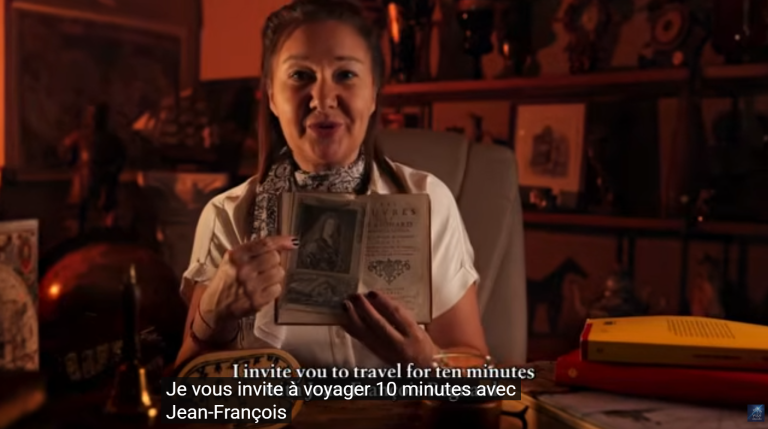
The first inscription carved into a wooden slab was left by the French adventurer Jean-François Regnard (1655–1709). Requemora recounts Regnard’s story in the first episode of the video series Voyager 10 mn avec Jean-François Regnard, produced by the French Centre de Recherche sur la Littérature des Voyages (CRLV).
Requemora compares the marks left by French travellers to the stone pillars (padrões) erected by Portuguese explorers as imperial symbols of claiming possession of distant lands.
The wooden slabs of Jukkasjärvi likewise served as markers of a conquered territory, although not in a political, governmental, or commercial sense. Through these inscriptions, travellers sought honour and immortality, Requemora writes.
The memorial slabs were created in a spirit of reuse. The inscriptions were carved into parts of discarded objects. The text left by Regnard’s party was carved into the rear board of a sled. In the photograph below, it is the uppermost slab.
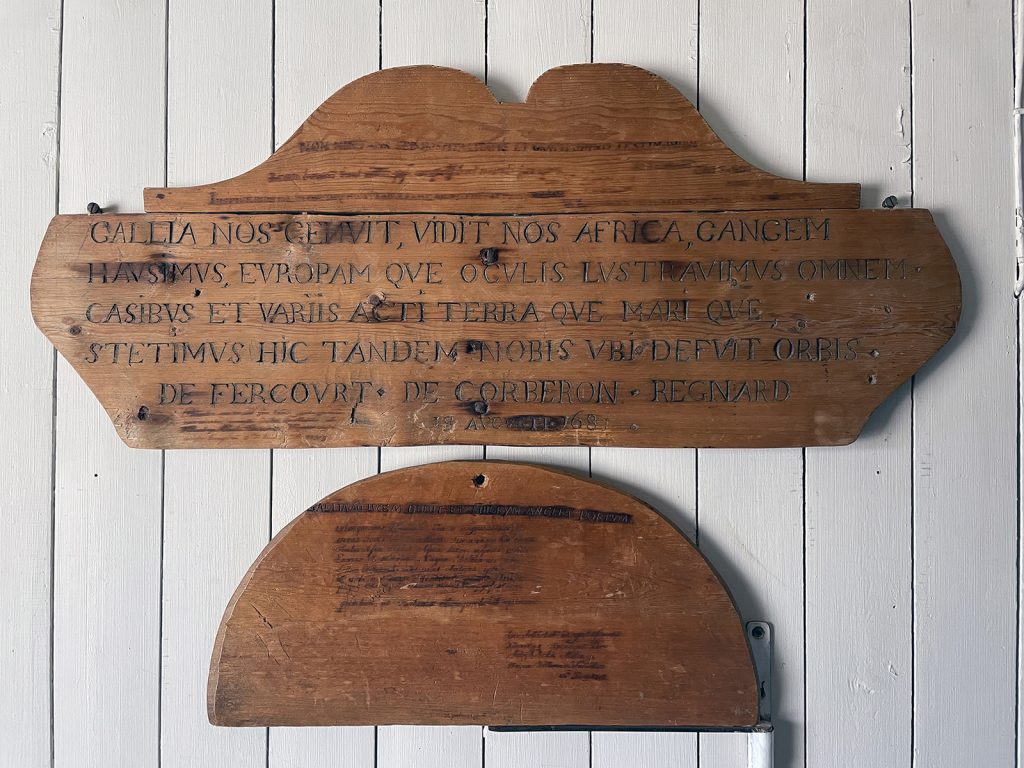
Regnard’s travelling party left the following inscription in Latin on their memorial slab:
Gallia nos genuit, vidit nos Africa, Gangem
Hausimus, Europam que oculis lustravimus omnem:
Casibus et variis acti terra que mari que,
Hic tandem stetimus, nobis ubi defuit orbis.De Fercout, De Corberon, Regnard
18 Augusti 1681
France gave us birth; Africa saw us. We drank from the Ganges
and surveyed all of Europe with our own eyes.
Driven by many adventures, by land and by sea,
we finally came to a halt here, where the world came to an end for us.De Fercourt, De Corberon, Regnard
18 August 1681
The inscription alludes to the epitaph of the Roman poet Virgil (70 BCE–19 BCE): Mantua me genuit, Calabri rapuere, tenet nunc / Parthenope; cecini pascua, rura, duces. (In English Mantua gave me birth; Calabria took me away; now Naples holds me. I sang of shepherds, fields, and heroes.)
The same text was, according to Regnard’s account, also carved on the summit of Bieskečohkka, a mountain near Lake Tornio. Today, the location of the possible inscription is unknown.


Aubrey de La Motraye’s Memorial Slab, 1718
Another French traveller, Aubrey de La Motraye (1674–1743), journeyed through Lapland in 1718. When he arrived at Jukkasjärvi, he found the memorial slab left by Regnard on the church altar.
De La Motraye also met a local resident who had guided Regnard’s travelling party thirty-seven years earlier.
The guide took De La Motraye to Bieskečohkka and showed him the inscription that Regnard’s party had carved into the mountain. Since then, however, no later reports of the carving being rediscovered have emerged. An interesting account of the search can be found on the Swedish website Utsidan, where Joel Johansson describes his attempt to locate Regnard’s rock inscriptions during Midsummer 2007.
Also worth reading is the appeal by K. B. Wiklund, Professor of Finno-Ugric Languages at Uppsala University, published in the Swedish Tourist Association’s yearbook in 1904, encouraging readers to search for the inscription: En liten uppgift att lösa vid Torne Träsk.
As a linguist, Wiklund also examined the name of the mountain. De La Motraye referred to the place as Pescomarca. In addition to Bieskečohkka, other known names for the mountain include Pieksenjarka, Pieksennenä and Piekse Nenävaara.
De La Motraye also left an inscription of his own at Jukkasjärvi. The text was carved into a semicircular piece of wood. It imitates Regnard’s style but lists a longer series of places visited by the traveller. Unfortunately, the small inscription is rather difficult to read.
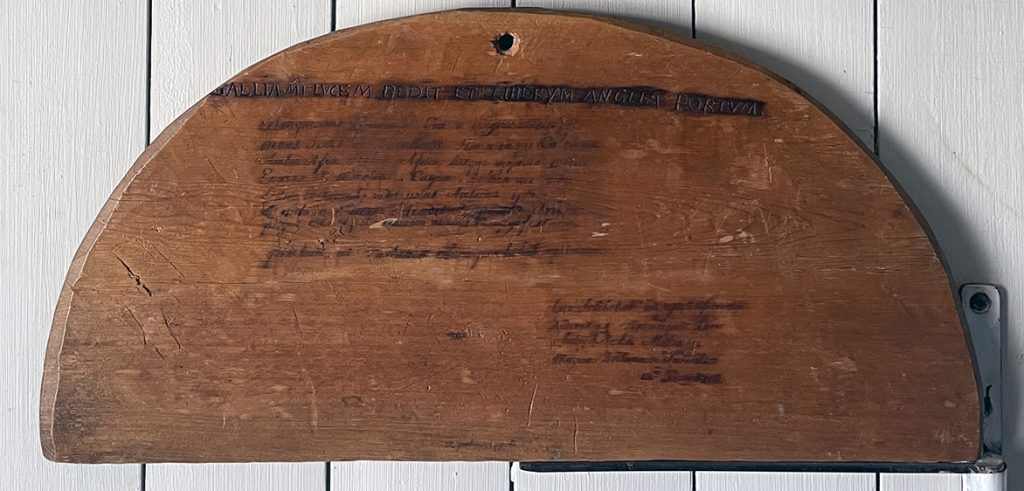
Gallia mihi lucem dedit, et liberum Anglia pourtum; utraque me Germania, Graecia magna monorque, mons Jovis, ac Barcellona, Herculisque columnae, ambae Asiae, Italia, Africa, hisque opposita Melite, Euxina et Maeotica, Caspia, Baltica necnon littora viderunt, vidit Polus Arcticus ipse, et mihi inocciduum ostendit Laponia solem; proque cibo et potyu carnem et lac rangiferinum praebuit, ut Tartaria olim praebebat equinum.
Haec scribebat ad Jukasjerviam, rediens ex
Torniavensi lacu, Aubri de la Motraye, Magnae
Brintanniae subditus, 13 junii 1718.
France gave me life, and England a free harbour; both Germanys saw me, as did greater and lesser Greece, Mount Jove and Barcelona, the Pillars of Hercules, both Asias, Italy and Africa, as well as Malta opposite them. The shores of the Black Sea, the Sea of Azov, the Caspian and the Baltic also beheld me. The Arctic Pole itself saw me, and Lapland showed me the midnight sun. For food and drink it provided me with reindeer meat and milk, just as Tartary once provided horse meat.
These words were written at Jukkasjärvi, on the return from Lake Tornio, by Aubry de La Motraye, subject of Great Britain, on 13 June 1718.
Gabriel Gyllengrip’s and Johan Wegelius’s Memorial Slabs, 1736
The third wooden slab is connected to Pierre Louis Moreau de Maupertuis’s geodesic expedition. Maupertuis himself never travelled as far as Jukkasjärvi, but at the same time he was in the North, the Governor of West Bothnia, Gabriel Gyllengrip (1687–1753), was also travelling in the region. Their paths crossed several times during the summer of 1736.
The third wooden slab in Jukkasjärvi is double-sided. One side bears the inscription of Governor Gyllengrip, while the other contains a long poem by Johan Wegelius (1693–1764). At the time, Wegelius was a teacher at the Torneå Pedagogium. He belonged to the social circle surrounding Maupertuis’s expedition in Torneå. A learned man with extensive knowledge of the Torne Valley, Wegelius also provided the expedition with invaluable local expertise.
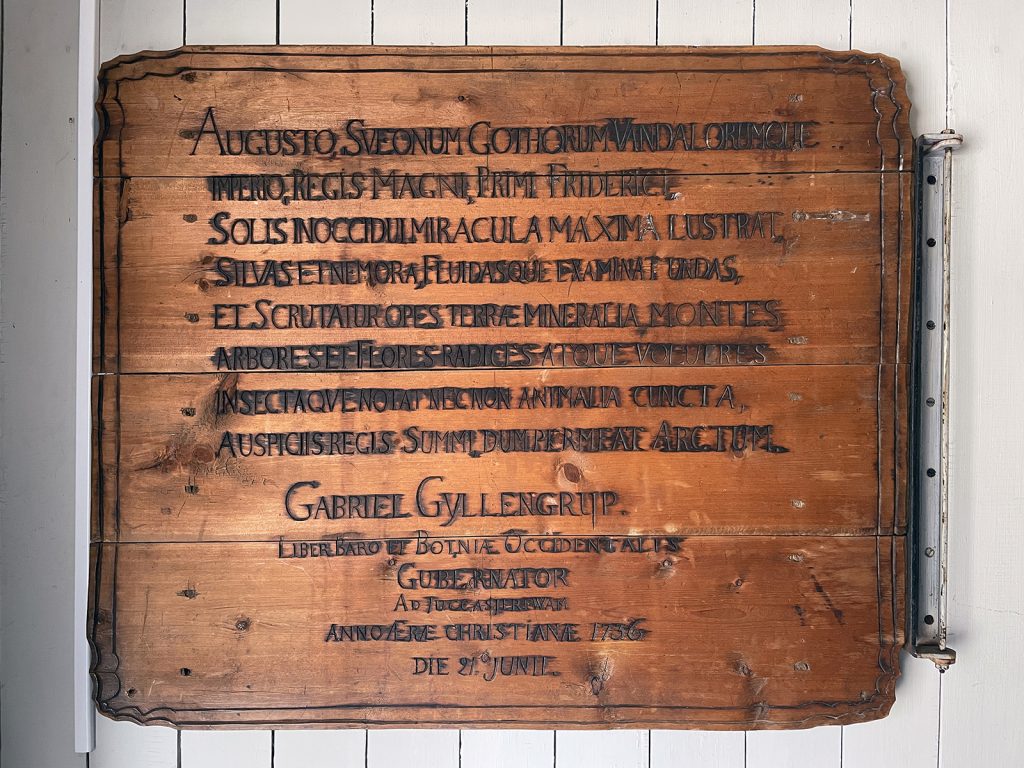
Gabriel Gyllengrip’s signed text is also written in Latin, in keeping with the learned conventions of the period:
Augusto Sveonum Gothorum Vandalorumque
Imperio, regis magni, primi Friderici
solis inoccidui miracula maxima lustrat,
Silvas et nemora fluidasque examinat undas
Et scrutatur opes terrae mineralia, montes
Arbores et flores, radices atque volucres
Insectaque notat nec non animalia cuncta,
Auspiciis regis summi, dum permeat Arctum.Gabriel Gyllengrip,
liber baro et Botniae occidentalis gubernator
ad Juccasjeriwam,
anno erae christinae 1736 die 21 Junii.
August Frederick, the great king of the Swedes, Goths and Vandals,
surveys the greatest wonders of the never-setting sun.
He examines forests and groves and the flowing waters,
and investigates the mineral riches of the earth, the mountains,
the trees and flowers, the roots and the birds;
he records the insects as well as every kind of animal,
under the auspices of the supreme king, while he traverses the Arctic.Gabriel Gyllengrip,
Baron and Governor of West Bothnia,
at Jukkasjärvi,
on 21 June 1736 in the Year of Our Lord.
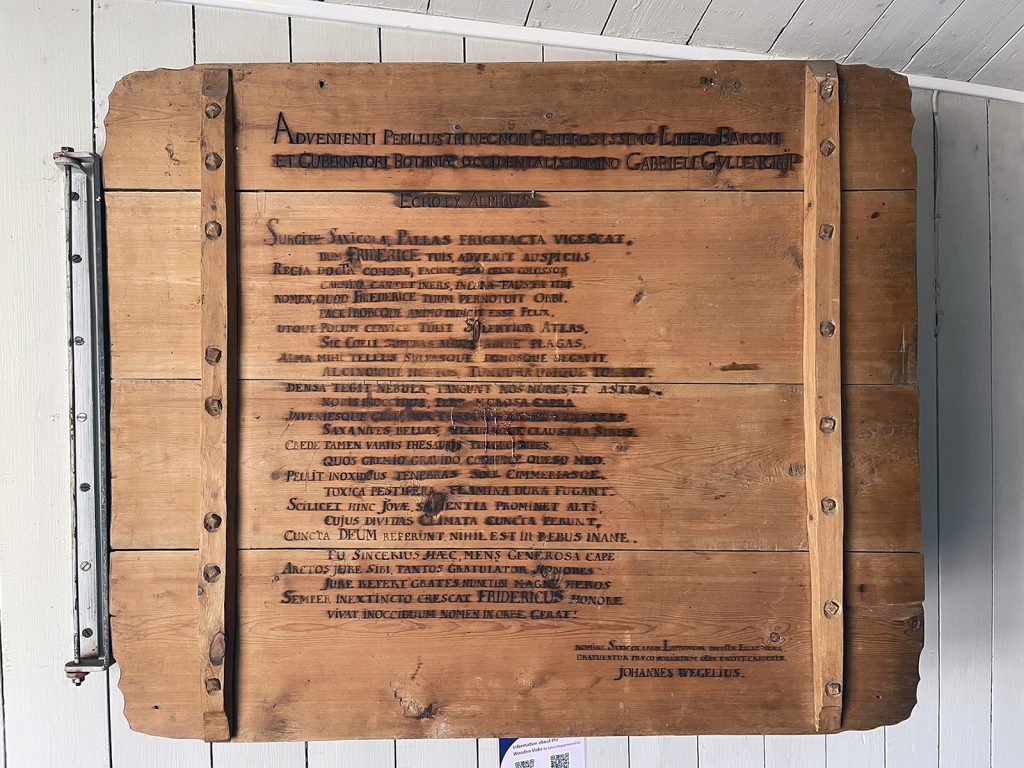
Johan Wegelius wrote a poem addressed to Gabriel Gyllengrip, praising the King of Sweden and the abundant natural resources of the North.
The objective of both the Swedish state and Governor Gyllengrip was to bring the hidden natural resources of Västerbotten County into use. In the same year that Maupertuis’s expedition arrived in the Torne Valley, Gyllengrip was commissioned to organize an expedition to the northern parts of the kingdom.
Gyllengrip travelled from Umeå via Torneå to the Kengis ironworks at Pajala and from there to Jukkasjärvi Church. During this journey, Gyllengrip’s party examined the mineral deposits of Kiirunavaara and Luossavaara and made numerous observations of ore. One hundred and fifty years later, Luossavaara-Kiirunavaara Aktiebolag, known as LKAB, was founded.
Advenienti perillustri necnon generosissimo libero baroni
et gubernatori Botniae occidentalis domino Gabrieli Gyllengrijp.Echo ex alpibus:
Surgite, saxicolae, Pallas frigefacta vigescat;
Dum, Friderice, tuis advenit auspiciis
Regia docta cohors, facient juga celsa colossos
Carmina cantet iners incola fausta tibi.
Nomen quod, Friederice, tuum pernotuit orbi,
Pace troboque animo didicit esse felix;
Utque polum cervice tulit solertior Atlas,
Sic coeli superas audet adire plagas.
Alma mihi tellus sylvasque domosque negavit
Alcinoique hortos: fulgura ubique tonant,
Densa tegit nebula, tangunt nos nubes et astra,
Nobis inoccidua fert morosa Capra;
Inveniesque gelu, mox turbines atque tenebras
Saxa, nives, beluas, clausaque claustra sinus.
Crede tamen, variis thesauris turgeo dives,
Quos gremio gravido conspice, quaeso, meo:
Pellit inoxiduus tenebras Sol Cimmeriasque,
Toxica pestifera flamina dura fugant.
Scilicet hinc Jovae sententia prominet alti,
Cujus divitias climata cuncta ferunt.
Cuncta Deum referunt, nihil est in rebus inane;
Tu sincerius haec, mens generosa, cape.
Arctos jure sibi tantos gratulator honores,
Jure refert grates nunc tibi, magne heros.
Semper inextincto crescat Fridericus honore,
Vivat, inocciduum nomen in orbe gerat!Nomine saxicolarum Lapponum incultae litterturae
Gratulatur praeco eorundem olim Enotecrensis
Johannes Wegelius
To the most illustrious and noble Baron and Governor of West Bothnia, Gabriel Gyllengrip, on his arrival.
An Echo from the Mountains:
Rise, dwellers among the rocks, let frozen Pallas flourish once more, for, Frederick, under your auspices the learned royal company arrives. Let the lofty fells become giants, and let the simple inhabitant sing auspicious songs in your honour.
Your name, Frederick, renowned throughout the world, has learned to bring happiness in peace and in labour alike. And just as skilful Atlas bore the heavens upon his shoulders, so it dares to ascend the highest regions of the sky.
A kindly land has denied me forests and homes and the gardens of Alcinous; everywhere thunderbolts resound. Dense mist covers us, clouds and stars touch us, and the lingering Goat brings us a sun that never sets.
There you will find frost, then whirlwinds and darkness, rocks, snow, wild beasts, and enclosed bays. Yet believe me, I abound in many treasures; look, I pray, upon the riches borne in my fruitful bosom.
The unsetting sun drives away the darkness and the Cimmerian gloom; harsh and pestilential winds are put to flight. Surely herein is revealed the will of lofty Jupiter, whose riches are proclaimed by every climate.
All things bear witness to God; nothing in creation is without purpose. Receive these truths with sincerity, noble-minded sir. The North rightly congratulates itself on such honours, and rightly now offers thanks to you, great hero.
May Frederick forever increase in undying glory; may he live, and may his name endure throughout the world forever!On behalf of the rock-dwelling Lapps, unversed in letters, their spokesman and former pastor of Enontekiö, Johannes Wegelius.
The Latin texts have been transcribed by Sylvie Requemora. The Finnish translations of the Latin texts were produced with the assistance of artificial intelligence.
Sources:
Sylvie Requemora. “Signs of Travel and Memory: The Case of the Wooden Slabs in Jukkasjärvi (1681–1736) “. In Time and Temporalities in EuropeanTravel Writing. Edited by Paula Henrikson ja Christina Kullberg, London and New York, Routledge, 2021, pp. 75-100.
Links to publications in Swedish:
Joel Johansson attempted to find Regnard’s party’s inscriptions on Bieskečohkka in 2007: https://www.utsidan.se/cldoc/vid-vaerldens-aende_1202.htm
Kjellman, Hilding; ”Regnards resa i Lappland”. Ur Svenska Turistföreningens Årsskrift 1931. Stockholm 1931. https://runeberg.org/stf/1931/0269.html
Wiklund, K. B.; ”En liten uppgift att lösa vid Torne träsk”. Ur Svenska Turistföreningens Årsskrift 1904. Stockholm 1904. https://runeberg.org/stf/1904/0411.html